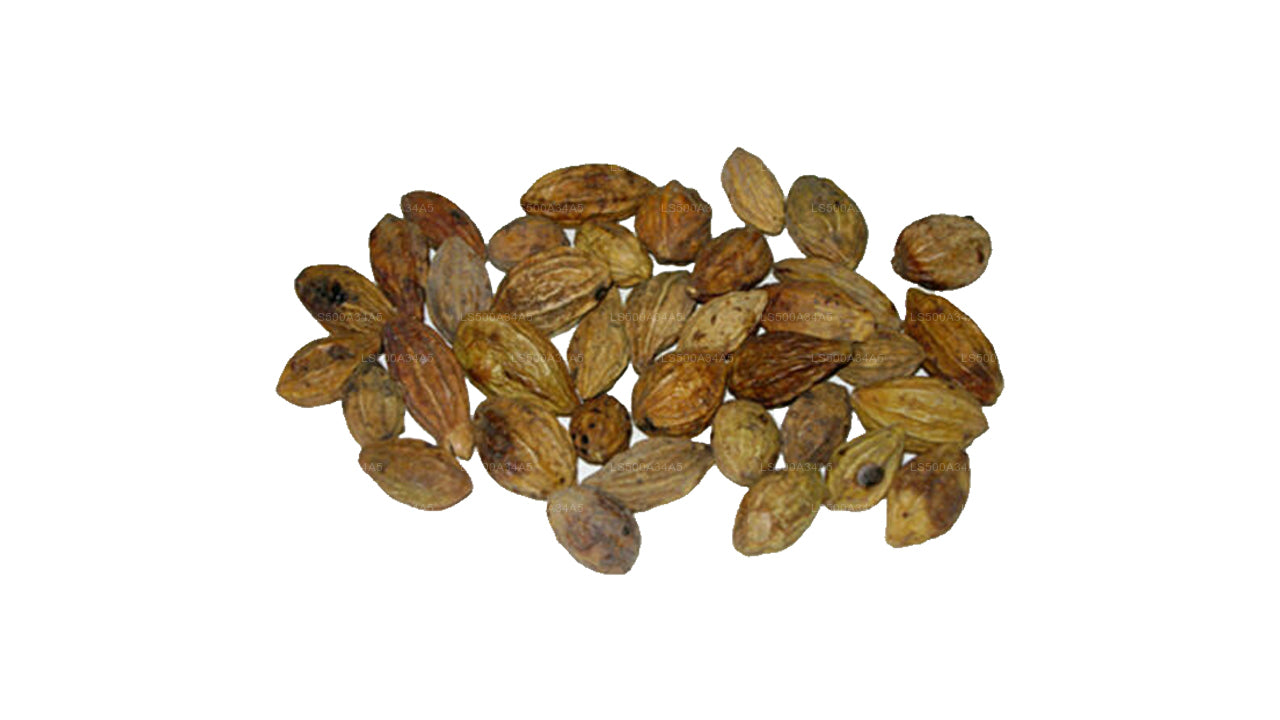
Terminalia chebula — known as Aralu in Sinhala, Haritaki in Sanskrit, and Myrobalan in English — is one of the most celebrated medicinal plants in South and Southeast Asian traditional medicine. A deciduous tree native to the Indian subcontinent and Sri Lanka, it has been prescribed in Ayurveda, Siddha, and Unani systems for well over two thousand years. Today, modern pharmacological research is beginning to validate what practitioners long observed in practice.
What is the botanical profile of Terminalia chebula?
Terminalia chebula belongs to the Combretaceae family and shares its genus with the related Terminalia catappa (Kottamba). The tree can reach up to 30 metres in height and is easily recognised by its rounded crown, dark-brown fissured bark, and elliptical dark-green leaves arranged in opposite pairs. It thrives in tropical and subtropical environments — deciduous forests, dry plains, and riverbanks — across India, Sri Lanka, Nepal, and parts of mainland Southeast Asia.
- Scientific name: Terminalia chebula
- Family: Combretaceae
- Common names: Aralu (Sinhala), Haritaki (Sanskrit), Chebulic Myrobalan (English)
- Flower: Small, yellowish-white, clustered in terminal spikes
- Fruit: A drupe, yellow to orange-brown when ripe, enclosing a single hard seed
The fruit is the part used most extensively in medicine. Depending on the stage of ripeness at harvest and the preparation method, its therapeutic profile can shift — unripe fruits tend toward stronger astringency, while fully ripe fruits carry a gentler, more digestive character.
How has Aralu been used in traditional medicine?
In Ayurveda, Haritaki is ranked first among the three fruits that make up Triphala, the foundational herbal compound used across thousands of classical formulations. The other two are Amalaki (Phyllanthus emblica) and Bibhitaki (Terminalia bellirica). This status reflects how comprehensively Aralu addresses multiple body systems simultaneously. It is considered to balance all three doshas — Vata, Pitta, and Kapha — a rare quality in Ayurvedic classification.
Traditional practitioners have documented its use for the following conditions, many of which are now subjects of active scientific inquiry:
- Digestive support: Mild laxative action, relief from constipation, and improvement of bowel regularity
- Detoxification: Cleansing of the gastrointestinal tract and elimination of metabolic waste
- Respiratory conditions: Management of cough, sore throat, and asthmatic presentations
- Immune modulation: Regular use traditionally associated with improved resistance to seasonal illness
- Anti-inflammatory applications: Preparations used for joint pain and inflammatory conditions, including early arthritic presentations
- Topical wound care: Paste or decoction applied externally to ulcers, fungal infections, and slow-healing wounds
In Sri Lanka's Yogaraja Guggulu formulations and related classical preparations, Aralu frequently appears as a supporting ingredient, reinforcing the tree's deep integration into local healing tradition.
What does modern research say about Terminalia chebula?
Pharmacological interest in Terminalia chebula has grown considerably since the early 2000s, with peer-reviewed studies examining a range of bioactive compounds found in the fruit. The most significant phytochemicals include chebulic acid, ellagic acid, gallic acid, and a complex array of hydrolysable tannins — notably chebulagic acid and corilagin.
Key findings from published research include:
| Area of Study | Summary of Evidence |
|---|---|
| Antioxidant activity | High tannin and phenolic content demonstrates strong free-radical scavenging in multiple in-vitro studies |
| Antimicrobial properties | Fruit extracts show inhibitory activity against common bacterial strains, several fungi, and select viruses in laboratory settings |
| Blood glucose regulation | Animal and limited human studies suggest potential benefit in moderating postprandial blood sugar spikes |
| Cardiovascular support | Antioxidant and anti-inflammatory mechanisms may help protect vascular endothelium and modulate lipid profiles |
| Hepatoprotective effects | Extracts have shown liver-protective properties in animal models exposed to chemical toxins |
It is worth noting that most studies to date are in-vitro or animal-model research. Large-scale randomised controlled trials in humans remain limited, so while the evidence base is encouraging, clinical claims should be interpreted with appropriate caution. Individuals with specific health conditions should consult a qualified practitioner before incorporating Aralu into a therapeutic regimen.
Where does Aralu grow in Sri Lanka?
In Sri Lanka, Terminalia chebula is found naturally in the dry and intermediate zones, particularly in the dry lowland forests of the North Central and Northern provinces. The tree is also cultivated in home gardens and on small agroforestry plots across the island, where both the fruit and bark are harvested for household medicinal use. The dry-zone forests around areas such as Wilpattu National Park provide some of the most intact natural habitat where the tree grows alongside other indigenous dry-forest species.
Ecological conditions that suit the tree — well-drained soils, pronounced dry seasons, and moderate altitudes — are common across Sri Lanka's cultural heartland. Harvesting typically takes place between November and February, when the fruit reaches full ripeness and its bioactive compound concentration is at its peak.
How is Aralu prepared and consumed?
Preparation methods vary across traditions and intended uses:
- Decoction (kasaya): Dried fruit pieces boiled in water to produce a concentrated medicinal liquid, taken in small doses
- Powder (churna): Dried, ground fruit mixed with warm water or honey and consumed before or after meals depending on the indication
- Triphala formulation: Combined with Amalaki and Bibhitaki in equal proportions — one of the most widely used Ayurvedic preparations globally
- Topical paste: Powdered fruit mixed with water or sesame oil and applied to the affected area for wound care
- Dehydrated seeds: Dried whole or halved fruits used in preparation of home remedies or stored for extended shelf life
In Sri Lanka, a simple folk remedy involves soaking a dried Aralu fruit in warm water overnight and drinking the infusion on an empty stomach — a practice reported to support digestion and regularity. Similar preparations are widely discussed in the context of Kaishore Guggulu and other classical compound medicines that draw on Aralu's astringent and detoxifying properties.
Is Terminalia chebula safe to use?
Aralu is generally regarded as safe for most adults when used in moderate, traditionally specified quantities. However, its strong astringent and mild laxative properties mean that overuse can lead to digestive discomfort. It is typically avoided during pregnancy and is not recommended as a standalone laxative for individuals with inflammatory bowel conditions without professional guidance. Quality of sourcing matters considerably — wildcrafted, naturally dried fruit tends to preserve a more complete phytochemical profile than heavily processed commercial extracts.