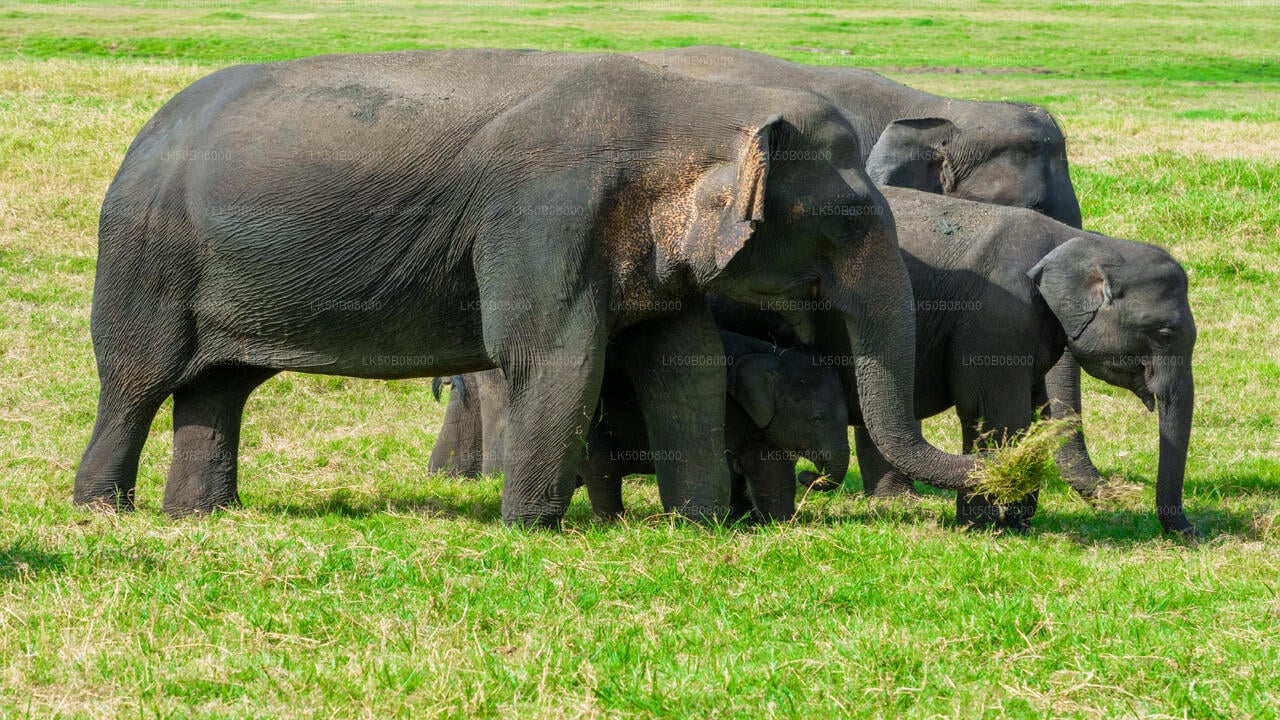
Every year, as the dry season tightens its grip on Sri Lanka's North Central Province, something remarkable unfolds on the open grasslands surrounding Minneriya reservoir. Hundreds of wild Asian elephants converge on the receding shoreline — socialising, bathing, grazing, and occasionally sparring — in what is widely regarded as the largest single gathering of Asian elephants on Earth. This is simply called The Gathering, and it is one of the genuinely rare wildlife spectacles left in Asia.
What exactly is the Elephant Gathering?
The Gathering is a seasonal congregation, not a migration in the strict biological sense. As the dry season reduces surface water across the region, the ancient tank at Minneriya — built by King Mahasena in the 3rd century AD — retains water longer than the surrounding scrub forest. Its receding edges expose a lush fringe of fresh grass, which draws elephants from across the Minneriya–Kaudulla–Hurulu forest corridor. At peak times, observers have counted between 150 and 400 elephants in a single afternoon, spread across the open plain in full view from safari vehicles.
Beyond sheer numbers, what makes The Gathering compelling is the breadth of behaviour on display. Family herds interact, young bulls test their strength, calves play in the shallows, and adults roll in the mud to cool down and protect their skin. Opportunities to watch complex elephant social dynamics — ordinarily hidden deep in forest — are unusually clear here.
When is the best time to see the Elephant Gathering?
The Gathering typically builds through July and peaks during August and September, when the drought is at its most intense and the grasslands around the reservoir are at their most productive. By October, rains begin to refill tanks across the district and the herds disperse. For the densest concentrations and the best light, late afternoon game drives — roughly 3 pm to 6 pm — are the most rewarding.
| Month | Elephant Activity | Crowd Level |
|---|---|---|
| July | Herds beginning to congregate | Moderate |
| August | Large herds present; peak viewing | High |
| September | Peak concentrations; 200–400 animals possible | High |
| October | Dispersal begins as rains arrive | Lower |
Where does the Gathering take place — and which park should I visit?
Three protected areas share the same forest corridor and collectively host the elephant population throughout the year: Minneriya National Park, Kaudulla National Park, and Hurulu Eco Park. The elephants move between them seasonally, following water and fresh grazing.
- Minneriya National Park — The classic venue for the Gathering, and the most visited. July to September is prime season here. The park lies around 180 km from Colombo, close to the ancient city of Polonnaruwa.
- Kaudulla National Park — As Minneriya's tank refills in October and November, large herds shift north to Kaudulla, which becomes the better option later in the year. The two parks are only about 25 km apart.
- Hurulu Eco Park — Further west toward Habarana, Hurulu sees elephants during the inter-monsoon months and offers a quieter, less crowded alternative to the other two.
Rangers and local naturalists track the herds daily, so checking current conditions before you visit is worthwhile. Reputable operators adjust itineraries between Minneriya and Kaudulla based on where the elephants are on any given day.
How do I get to Minneriya National Park from Colombo?
Minneriya is roughly a 4–5 hour drive from Colombo via the A6 highway through Kurunegala and Dambulla, or a slightly longer route through Kandy. The nearest town with a good range of accommodation is Habarana, about 25 km from the park entrance, which also gives easy access to Kaudulla and Hurulu. There is no direct public transport to the park gate; a private vehicle or organised transfer is the practical choice for most visitors.
What wildlife will I see besides elephants?
The open, semi-arid habitat around the reservoir supports a broader cast of species. Spotted deer, sambar, wild boar, and purple-faced langurs are common throughout the year. Minneriya is also a rewarding destination for birdwatchers: the reservoir hosts large flocks of lesser whistling duck, painted storks, and several kingfisher species. Leopards are present in the park but rarely seen in the open terrain near the tank.
What is the history behind the Gathering?
The behaviour almost certainly dates back millennia — the Minneriya tank itself was constructed around 1,700 years ago and has been drawing wildlife to its banks ever since. The phenomenon only entered mainstream wildlife literature relatively recently, and has since been ranked among the top wildlife spectacles in Asia by multiple international travel publications. Sri Lanka's Department of Wildlife Conservation designated Minneriya as a national park in 1997, partly to protect this annual event and the habitat that makes it possible.
It is worth noting that Sri Lanka holds one of the highest densities of wild Asian elephants in the world relative to its land area. The island's population is estimated at around 6,000–7,000 individuals — a significant proportion of the global total for Elephas maximus. Conservation work such as the Elephant Transit Home at Udawalawe plays an important role in supporting orphaned calves and maintaining this population.
How should I prepare for a safari at Minneriya?
A few practical points that make the experience considerably more comfortable:
- Wear neutral, earth-toned clothing — bright colours can disturb wildlife and make elephants uneasy at close range.
- Bring a hat, sunscreen, and drinking water; the open terrain around the reservoir provides almost no shade.
- A pair of binoculars improves the experience substantially, particularly for birdwatching along the tank edge.
- A camera with a telephoto lens (200 mm or longer) is recommended; you will typically observe elephants from 20–100 metres but the best shots often require reach.
- Afternoon drives offer the best light and the highest elephant activity. Morning drives are quieter but still rewarding.
- All visitors must enter the park in a registered jeep with a licensed tracker or naturalist guide. Solo entry is not permitted.
Is the Elephant Gathering suitable for children?
It is an excellent experience for older children who can sit quietly in a moving jeep for two to three hours. The open terrain means visibility is good even from a seated position, so younger children are not at a disadvantage. Infants and very young toddlers may find the heat and duration challenging during peak season. Most safari operators can accommodate families and will advise on appropriate drive lengths.